Friday, October 23, 2009

Sweetened condensed coco milk

Ingredients

          Coco skim milk
          Coco cream (gata)
          Refined sugar
          Agar-agar

Utensils:

          Double boiler
          Wooden spatula
          Glass jars

Procedure

  Dissolve sugar in the skim milk.  Add 1 tbsp coco cream to every cup of coco skim milk.  Cook at medium heat in double boiler and stir until thick.  Small amount of agar-agar may be added to give body to the product.

Tuesday, October 20, 2009

How to make coconut vinegar

I.  Ingredients

Coconut water                             8 cups
Sugar                                          1 cup
Fleichman's yeast                         1/2 tsp
Ordinary vinegar from                   1 1/2 cups
   nipa or coconut sap

II.  Procedure

  Strain coconut water thru muslin cloth.  Add 1 cup of refined sugar to eight cups of strained coconut water.  Boil for 5 minutes.  Cool in sterile glass containers and cover with paper to avoid contamination.  Add 1/2 tsp of Fleicman's yeast and allow to ferment (around 1 week).

Siphon the clear solution into wide-mouthed sterilized glass jars.  Inoculate with 1 1/2 cups of ordinary vinegar from nipa or coconut sap which is available in the market.  A thin film will grow on the surface which should be a good sign.  Allow to ferment at room temperature.  Vinegar fermentation takes 2 to 3 months.

Siphon the vinegar and pasteurize at 60 deg C for 10 minutes.  Age in barrels.

Monday, October 19, 2009

How to make salted eggs

Ingredients:


Fresh Eggs
1/2 cup canning salt
water

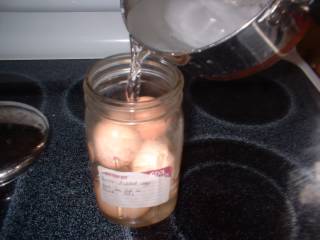
The eggs should be submerged for weeks in a supersaturated salt solution. Fit in as much eggs as I could in a wide-mouthed quart jar. Then I fill it with water and pour it off to a small saucepan to approximate the amount needed to boil (of course add a bit more water for allowance).

Boil the water and continuously add canning salt (I used Morton) by 1-2 tbsp increments to fully dissolve it up to a point when it could no longer dissolve (which is called the supersaturated salt solution).  Let it cool down. Since heat increases solubility, it was expected that some salt re-crystallized as the solution cooled.

Pour the solution into the jar with the eggs, making sure that the eggs are fully submerged. (If eggs tend to float as the saltiness increases buoyancy, you should add some weight to it). Cover with a cheesecloth like so and used the screw band to secure it in place (you may use rubber band for the purpose). Notice that a label containing the date of start is placed. Wait waited until the 25th day, when my friend Ana was here and we shared pinangatthat she cooked.

Boil the eggs in the brine itself for 10 minutes then submerg them in cold water, and cube them, then mix with diced fresh red ripe tomatoes. 


An alternative way to salt eggs in clay

1.  Mix 12 cups of clay and 12 cups of salt, adding water until well blended

2.  Apply a generous portion of this mixture at the base of an earthenware pot

3.  Coat each of the eggs with the mixture

4.  Arrange in layers and allow 1-2 inches in between to prevent breakage

5. Cover with  extra mixture and store

6.  Try eggs after 15 days.  If not salty enough, extend storing period

7.  When ready, boil eggs for 5 minutes, and let stand 10 more minutes.

8.  Color eggs, if desired.

How to make rice wine

Ingredients:

  • 2 Gallons of Water, boiled and cooled
  • 3 small cakes (pouches) Fleishman's yeast
  • 4 lbs. of Rice
  • 6 lbs. of Sugar
  • 4 boxes of raisins
  • 2 oranges cut up
  1. Step 1.  After the water has cooled combine all the ingredients in a container. cover with a cloth

    Step 2.  Stir every morning for 21 days.

    Step 3.  Strain the wine through a colander lined with filter paper. Let filter through several days.

Sunday, October 18, 2009

How to make Soy Sauce

Home made soy sauce for home use or for business. 


Materials and Ingredients

  1. Raw materials
  • Soybean                            12 kilos
  • Wheat                               12 kilos
  • Salt                                    10 kilos
  • Water                                33 kilos
     2.  Additional materials

  • Brown sugar                      375 grams
  • Caramel                              70-190 grams
  • Amino acid                         0.18 liters
  • Salt                                      50 grams
  • Rice wine or cherry          20 cc
  • Acetic acid solution           2 cc
  • Monosodium glutamate   3 grams
     3.  Antiseptic materials
  • P. butylester of benzoic acid 1.0 gram
  • 5%  Sodium hydroxide     4.4 cc
Raw materials processing

A.  Soybean

  • Filter and remove the bad seeds then wash thoroughly.  
  • Change the water 5 to 6 times during washing
  • Soak the beans in water for 8 hours (The volume will increase around 2 times)
  • Peel the beans
  • Steam the beans in a pressure cooker, 15 lbs for 1 to 2 hours
  • If no pressure cooker, steam for 5 to 6 hours in regular steamer
  • After steaming, the beans will be very soft, it contains around 60% water
B.  Wheat

  • Clean the grains
  • Roast in a rotary roaster until the wheat turns golden in color
  • Break the peel to expose the white grain
  • The grains will float in water when done
  • Keep the roasted grains in a wooden box overnight
  • After leaving the grains overnight crush the wheat grains.
  • Separate the coarse from the fine particles using strainer
  • The ratio of crushed wheat is 25 percent fine and 75 percent coarse
Multiplying the Microorganism

1.  Mix the fine wheat powder and the starter  powder in a bowl.  Spread the cooked soybean on a mat.  Mix the coarse wheat with the cooked soybean.  Sprinkle the mixed powders and mix them thoroughly.  Heap the mixtures 15 to 18 cm thick.

2.  Put the mixture in small wooden boxes.

3. Keep the small wooden boxes inside a big wooden box under the following temperature:

  Room temperature...... 27 deg C
  Mixture temperature...35 deg C
  Room humidity      ........90 %

  Stage 1 - after 24 hours, stir the mixture very well

  Room temperature    ...26 deg C

  Stage 2 - after 6 to 7 hours from stage 1, the temperature of the mixture will go to about 29 deg   C.  Stire the mixture again.  Shuffle the placements of the small boxes - the middle boxes on
  top.  This will permit the development of the color of the microorganism in every box.

  Stage 3- After 15 hours from stage 2, the yellow spores will appear in the mixture.  Take the
  boxes ouf of the Koji room and cool them.

Control of the Fermenting Mixture

A.  Preparation of the wooden barrel:

Overhaul the barrel.  Remove the bad smell of the barrel by pouring in hot water and ash overnight or wash the same with 2% NAOH solution followed with H2SO4 solution and then with water.

B.  Preparation of the brine. Pour water in the barrel.  Add the proper amount of salt to make a brine concentration of 19.5Be.  Wrap the salt to be dissolved in cheesecloth.

C.  Mixing

After adjusting the salt concentration, add te final Koji (mixture of soybean and wheat).  Mix very well.

D.  For about a month, stir the mixture twice every day until he mixture is dissolved in brine.  After, stire the mixture once every 3 days for 6 to 8 months.

Pressing

After 6 to 8 months, fermentation is completed, press the mix using a presser.

1st day - put the mixture in a sack cloth (25 cm X 6m).  Heap them in a wooden box which has a hole where the soy sauce can flow into the container.  Do not press on the 1st day.

2nd day - press gradually

3rd day - change the heaping and press more.

4th day -  change the heaping and press

During the pressing, the volume of the raw soy sauce that can be obtained is 60 to 70 percent.  Keep the raw soy sauce in a jar for 3 to 5 days, then remove the sediments by decanting or siphoning.  Remove the soybean oil by skimming.

Pasteurizing

Pasteurize raw soy sauce in a double boiler at 70 deg to 80 deg C for 30 to 60 minutes.  At this point, add caramel, brown sugar, amino acid and cherry to raw soy sauce.

Keep the soy sauce in a jar for 7 days.  Remove the sediments.  Soy sauce is ready to be served.

How to make Catsup

Catsup or ketchup is one of the most widely used food condiment around the world.   It is based from tomatoes or bananas and can be used with a variety of food products.   This is a how-to-guide for a sweet and spicy tomato ketchup.


Ingredients:

1/2 cup of sugar
3 kilos of ripe tomatoes (fully ripe recommended)
1/2 cup vinegar
1/2 onion
t tbsp salet
1 tbsp (spices)
1/4 tsp chili sauce
Crushed chili pepper in small amount of water
  • Scald and peel the tomatoes
  • Cut into halves the tomatoes and remove the seeds
  • Strain the seeds and juice he add to pulp
  • Add onions ad boil until soft
  • Remove from the fire and strain
  • Add salt, sugar, vinegar and the spices wrapped in a piece of cloth
  • Cook to consistency of ketchup
  • Pour while hot in sterile bottle
  • Seal cool and label
You can add or reduce the quantity of flavorings according to your taste.  Process for a banana ketchup is the same.  Just replace the tomato with banana.  Enjoy your ketchup!


An introduction to a how to do guide

This is a how to do guide covering various topics.  From food, to computers to business.  I hope you'll find the content interesting and helpful.  Some of the stuff mentioned here are contributions by readers, we cannot be held liable for inaccuracies or damage incurred from following the articles. I hope you'll enjoy the content